Archive

Archive for the ‘Marketing’ Category

How to prepare for a career as a medical science liaison

February 8th, 2009

Medical Science Liaison jobs are often seen as the “Golden Ticket” for advanced degree holders looking at career options in the pharmaceutical industry. The thought of receiving a six-figure salary to travel from place to place discussing the latest scientific research is incredibly alluring, and many PhDs and postdocs see the skill sets required as a “perfect match” for their own experiences carrying out research and making presentations. But for most, MSL jobs remain out of reach, because they don’t think carefully about what the industry is looking for in applicants.

Approximately 80% of Medical Science Liaisons hold advanced degrees (PhD, PharmD or MD). Companies prefer to hire people with these degrees because they are seen as more credible when discussing scientific research, and because their advanced training gives them a kind of parity with the doctors they work with. If you don’t have an advanced degree, your chances of landing an MSL job are very limited, and if you do, it almost certainly won’t be your first pharma job. In your position, I would recommend approaching these MSL jobs laterally, by succeeding as a medical sales representative and switching over to the more consultative MSL role after proving yourself.

If you hold a  PharmD or MD, you don’t have the same hurdles to jump as PhDs, who may be perceived as too narrowly focused and insufficiently patient-centred. Instead, you simply need to continue developing your presentation skills and knowledge of the clinical trials process. Communication skills are the #1 challenge that limits the success of internationally-trained MDs in applying for MSL roles. If you think this might be the case for you, consider investing in an accent-reduction training program.

The remainder of this article will be most useful to those who are at the beginning or midway through a postgraduate program (PhD or possibly postdoc) in the life sciences.

Read more…

Marketing, Medical Science Liaisons, Resources, networking , , , , , , ,

How Technology Transfer jobs put your science to work

February 6th, 2009

Technology transfer is the conduit that helps transform public-sector science research into commercial applications, and it can transform a scientific career as well.

Many universities and public-sector research institutes have technology transfer (TT) offices. TT workers constantly observe the research being carried out, looking out for new discoveries that might have value outside the laboratory. They evaluate these technologies for commercial potential, and when an opportunity is found, they work with intellectual property experts to protect it, then seek out commercial partners who might license it. In some cases, the TT office will work to create a new company to commercialize a discovery.  On the “other side” of the equation, many Big Pharma and biotech companies have their own tech transfer teams to bring new technologies into the firm.

Jobs in technology transfer can be very rewarding for those who have spent a long time training in science because it is a career that lets you remain close to cutting-edge research and the thrill of new scientific discoveries.

A typical job description for an entry-level position in technology transfer as a life sciences licensing associate would be similar to the following:

Life Sciences Licensing Associate

Responsible for negotiating material transfer agreements (MTAs) and non-disclosure agreements (NDAs)  handled by the Technology Transfer office, including recording receipt of the document, pursuing the completion of agreements by communicating and negotiating with the other party in coordination with the case manager, obtaining signatures on final agreements and distributing completed agreement to all parties involved. Negotiation of these agreements is a highly technical scientific and legal task, and requires an advanced understanding of the university’s technology transfer policies.

Additionally, in concert with more senior licensing officers, you will be responsible for identifying and evaluating invention disclosures by faculty, staff, and students; obtaining appropriate intellectual property protections for inventions; marketing University-developed technologies to industry; participating in programs to educate researchers about technology transfer, and helping to develop a culture of entrepreneurship at the University.

REQUIREMENTS

Experience
2-3 years of experience in a biomedical research environment in an institutional or university setting.  Experience working with or processing MTAs and NDAs is preferred.

Education
A Bachelor’s degree in a life science field is required. Post-graduate work in a life science-based field, or a graduate business program (e.g., M.B.A) is strongly preferred.

A technology transfer position at this level would pay $45K or more to start.

If you are currently a student, you’re in a great position to learn more about these roles and make connections that may help you get a job when you graduate. By networking through your professors, you can probably wrangle an introduction to the Technology Transfer office at your university. Take advantage of the introduction to ask for an informational interview and ask for advice on preparing yourself for a career in this field. Many of these offices run programs which are meant to educate researchers about intellectual property and the role of the technology transfer group. Keep your eyes peeled and make a point of attending these information sessions, saying ‘hello’ and asking good questions.  Consider taking a business class or finding another way of developing some knowledge about business development, contracts and commercialization.  Many schools have student clubs that can provide you with this exposure. You might also consider joining the AUTM, an association for technology transfer professionals which offers a discounted student membership. Their website also offers a selection of freely-available resources that will help you learn about the field.

You can learn more about careers in technology transfer through the links below.

Business Development, Intellectual Property, Marketing, Technology Transfer , , , ,

Review: Career Opportunities in Biotechnology and Drug Development

January 14th, 2009

51o-cqei5ll_sl160_

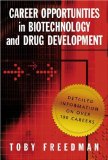
Here’s another great resource for your pharmaceutical job search: Career Opportunities in Biotechnology and Drug Development, by Toby Freedman.

Freedman has put together a solid resource for finding jobs and developing your career in the biotechnology and pharmaceutical industry. At 409 hardcover pages, this isn’t the kind of book you can slip in a pocket to browse on the subway — it’s a comprehensive guide that I could see being an invaluable aide to finding your first job in the biotech industry.

Early chapters on resume writing and interview techniques, including informational interviewing, are brief but well-written and useful. If you’ve read a lot of career guides, these chapters probably aren’t going to teach you anything you haven’t heard before.  The real meat of this book is the industry-specific information that follows.

In an excellent overview chapter, Freedman explains the breadth of the industry, and summarizes the different product development pathways followed by therapeutic, nontherapeutic, and medical device companies.

Next, individual chapters, each about 20 pages long, cover a wide range of career pathways: drug discovery, preclinical research, project management, clinical development, medical affairs, regulatory affairs, quality assurance and quality control, operations, product development, business development, sales, marketing, and corporate communications. Chapters on executive management, legal affairs, finance, management consulting and even recruiting round out this comprehensive guide.

Each chapter includes ’snapshots’ of various roles and offers a thoughtful analysis of both the positive and negative aspects of a given job.  For example, in clinical development, Freedman notes that “Original and applied clinical research is exciting.  Outcomes are unknown until trials are completed, and each trial is unique. Your work is close to the market”, but “There is frequent pressure to meet constantly looming deadlines, and the objectives often seem to be ‘too much, too soon, with too little’”. When you’re just starting out, and trying to decide what path to follow, knowing the downside of a job can be very useful information.

Naturally, salaries and compensation are a matter for discussion, as is the potential for career development, and a look at how future trends might influence job security for each role is useful in today’s economic times.

Perhaps most usefully for job seekers, Freedman clearly lays out job requirements and typical pathways into the role, and offers tips that could be helpful for getting one’s foot in the door.  Descriptions of what it takes to excel in a role, and qualities common to good candidates are also helpful.

This guide isn’t cheap, and it isn’t very portable — but if you are looking for a career in the pharmaceutical and biotech sector, this book should be at your side.

Clinical research, Interviewing, Marketing, Medical Science Liaisons, Preclinical R&D, Regulatory affairs, Resources, Resumes & CVs , , , ,

Fun distraction: make your own drug ads

October 28th, 2008

A while back I came across a couple of fun links that let you design your own drug advertising campaigns.

Holton Sentivan + Gury has a site that lets you direct your own TV spot.

Get Your Drug On lets you customize a print campaign and send it to your friends.

If you’re interested in a job in pharmaceutical marketing, we’ll discuss some real-life positions in a future article.

Fun, Marketing , , , ,